Wednesday, July 09, 2014

State Board of Education Testimony - July 9th, 2014

Good afternoon and thank you for the opportunity to testify this afternoon.

My name is Melissa Katz and I am 18 years old. I graduated from South Brunswick High School in 2013 and I am currently an Urban Elementary Education major at The College of New Jersey.

A little over a month ago, I posted a new profile photograph on Facebook, in which I was holding a sign that says "I AM MORE THAN A TE$T SCORE." I also had some words written on my face and neck - [and in case you're wondering, black eyeliner will do the trick]- like 'partially effective,' 'PARCC,' 'SGP,' 'accountability,' and 'high-stakes,' all which are considered to be ‘buzzwords’ in the education reform world. The point of using myself as a canvas was to express my concerns over being labeled by the system, both as a student and a future teacher. As a student, I was labeled by my NJASK score, and students will soon be labeled by their PARCC scores - especially in the high-stakes accountability environment of today's education reform. Teachers are being labeled by these new, unproven ‘growth’ measures, but deeper research into the use of student growth measures, specifically in New Jersey with Student Growth Objectives (SGO’s) and Student Growth Percentiles (SGP’s), reveals the risks of attaching student growth to consequences such as evaluating teachers, principals, and local public schools, and even further, teacher employment.   


In New Jersey under AchieveNJ, teachers are evaluated on Student Growth Objectives (SGO’s) and Student Growth Percentiles (SGP’s). SGO’s are defined by the state as “academic goals for groups of students that are aligned to state standards and can be tracked using objective measures.” SGP’s are defined by the state as “measure[ing] growth for an individual student by comparing the change in his or her NJ ASK [soon to be PARCC] achievement from one year to the student's "academic peers" (all other students in the state who had similar historical test results).” For teachers in tested grades and subjects, which currently include less than 20 percent of teachers, student achievement will make up 45 percent of a teacher’s evaluation: 15 percent student growth objectives and 30 percent student growth percentiles. For non-tested grades and subjects, which currently include more than 80 percent of teachers, student achievement will make up 15 percent of a teacher’s evaluation.
There are many issues surrounding the use of SGO’s and SGP’s in teacher evaluations, the largest being that there is no evidence to support their use. Bruce Baker of Rutgers University came to some of the following conclusions: (the entire report can be found here):


  1. “Student Growth Percentiles are not designed for inferring teacher influence on student outcomes;
  2. “Student Growth Percentiles do not control for various factors outside of the the teacher’s control;
  3. “Student Growth Percentiles are not backed by research on estimating teacher effectiveness. By contrast, research on SGP’s has shown them to be poor at isolating teacher influence;
  4. “Higher shares of low-income children and higher shares of minority children are each associated with lower average growth percentiles. This means that SGP’s – which fail on their face to take into account student background characteristics – fail statistically to remove the bias associated with these measures.
  5. “There are a magnitude of things that go on outside of the few hours a day where the teacher has contact with the child that influence any given child’s “gains” over the year, and those things that go on outside of school vary widely by children’s economic status.
  6. “Differences in student, classroom, and school level factors do relate to variations in both initial [student] performance levels and performance gains.
  7. Teacher’s aren’t all assigned similar groups of students with an evenly distributed mix of kids who started at similar points.”

FairTest, “The National Center for Fair & Open Testing (FairTest), works to end the misuses and flaws of standardized testing and to ensure that evaluation of students, teachers and schools is fair, open, valid and educationally beneficial.” The organization came to the follow conclusions:

Test-based teacher evaluation methods too often reflect the students teachers have, not how well they teach.Researchers calculate teacher influence on student test scores ranges from as little as 7.5% to 20% (Education Week, 2011). Out-of-school factors are the most important. As a result, test scores are greatly dependent on a student’s class, race, disability status and knowledge of English. Some value-added measures claim to take account of students’ backgrounds through statistical techniques. But the techniques do not adequately adjust for different populations or for the impact of things like grouping and tracking students. So the measures remain inaccurate (Darling-Hammond, et al., 2012; Baker, 2013).


Because of unreliable and erratic results, many teachers are incorrectly labeled “effective” or “ineffective.”On the surface, it makes sense to look at student gains, rather than students’ one-time scores. Measuring progress is important. However, VAM and growth measures are not accurate enough to use for important decisions. One study found that among teachers ranked in the top 20 percent of effectiveness in the first year, fewer than a third were in that top group the next year. Another third moved all the way down to the bottom 40 percent (Newton, et al., 2010). A RAND study found that using different math subtests resulted in large variations in teachers’ ratings, suggesting the measure, not the teacher, was the cause of the differences (Lockwood, et al., 2007). In some states currently using these methods, the results are no more accurate than flipping a coin (Baker, 2012).  


Going back to Bruce Baker for a moment, his in depth analysis of Student Growth Objectives (SGO’s) and Student Growth Percentiles (SGP’s) yielded the follow conclusions:


“Teachers in high poverty schools are dealing with children who have initially lower performance as defined by their test scores. Based upon this measure, they will have lower SGP’s, and now we begin the reform process of telling the narrative that these teachers are failing their students and must be replaced with new Teach for America grads who will be sure to magically turn things around and get those scores up!


“There are three ways the state plans to use SGP’s: rating schools for interventions, employment decisions, and evaluating teacher preparation institutions such as colleges and universities. In all of these cases, the use of SGP’s is inappropriate. SGP’s are not designed to determine a teacher’s or a school’s effect on test scores; again, they are descriptive, not causal, measures. Further, the bias patterns found in SGP’s provide a disincentive for teachers to teach in schools with large number of low-income students.”


Pursuing a policy of dismissing or ‘detenuring’ at a higher rate, teachers in high poverty schools because of their lower growth percentiles, would be misguided. Doing so would create more instability and disruption in settings already disadvantaged, and may significantly reduce the likelihood that these schools could then recruit “better” teachers as replacements.
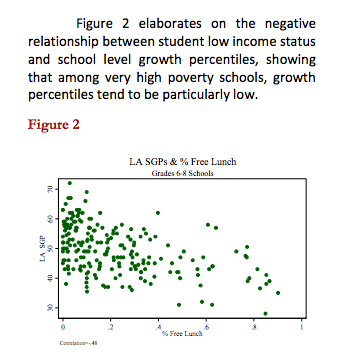

Screen Shot 2014-06-30 at 11.23.02 PM.png
http://njedpolicy.files.wordpress.com/2013/05/sgp_disinformation_bakeroluwole1.pdf
Future teachers are going to be discouraged from wanting to enter urban districts, where strong, dedicated, and committed teachers are most needed. All of these new reforms - most specifically new teacher evaluation systems focused heavily on ‘student growth’ and the over-reliance on high-stakes standardized testing - are pushing away good, future teachers who are yet to even step foot in a classroom.


I've said it before and I'll say it again - in the education reform world, if it isn't quantifiable, it isn't important. But in the real world, it's those exact characteristics that aren't quantifiable which are truly important - the characteristics that make each student individual, creative, and passionate.


Why would a young, aspiring teacher voluntarily put themselves in a situation where they will be judged based on factors that they do not control, and have that judgment decide whether or not they can keep their job and livelihood?


I don’t know the answer to that. But I do know that telling future teachers not to go into teaching, or to change their major away from urban education studies, is not the answer.


Sadly, the relationships that teachers develop with their students mean nothing in this day and age of reform accountability. What about those endless hours that teachers spend grading papers, designing projects, and perfecting that lesson plan so that their students can reach their full potential and blossom? Well, that can't be measured, so administrators, districts, and states don’t care about that (not to suggest that all admins and school districts support these reforms - many times they are tied by the state mandates).


But the beautiful thing is that one group of people do still care about all of those "unmeasurable" aspects of education - teachers.


Teachers know that you can't measure the joy and pride a student feels when they finally figure out that math problem they always struggled with. Teachers know that you can't measure the feeling of self-confidence and self-worth a student experiences when they nail that presentation they worked so hard on by overcoming their fears of being in front of a class. Teachers know that you can't measure the bond between students and teachers, both individually and as a class, because for many students in urban districts school is the one safe place where they know they will be loved and supported. As Nicholas Ferroni, educator and author, best states: "Students who are loved at home, come to school to learn, and students who aren't, come to school to be loved."

Unfortunately, nothing I am presenting here hasn’t been presented before. Even more unfortunate, people who have the power to make change - those at the state level specifically - are choosing to ignore this evidence and move forward with unproven, untested reforms in hopes that hey, maybe it’ll all work out. But the most effective and widespread change happens from the bottom up, so we must continue to educate one another, which in turn will only empower and strengthen the grassroots movement and build momentum through truth to counter the reforms that are being implemented in an untested, unproven, and undemocratic way.  

Wednesday, July 02, 2014

My Open Response to Assemblyman Jack Ciattarelli's Letter

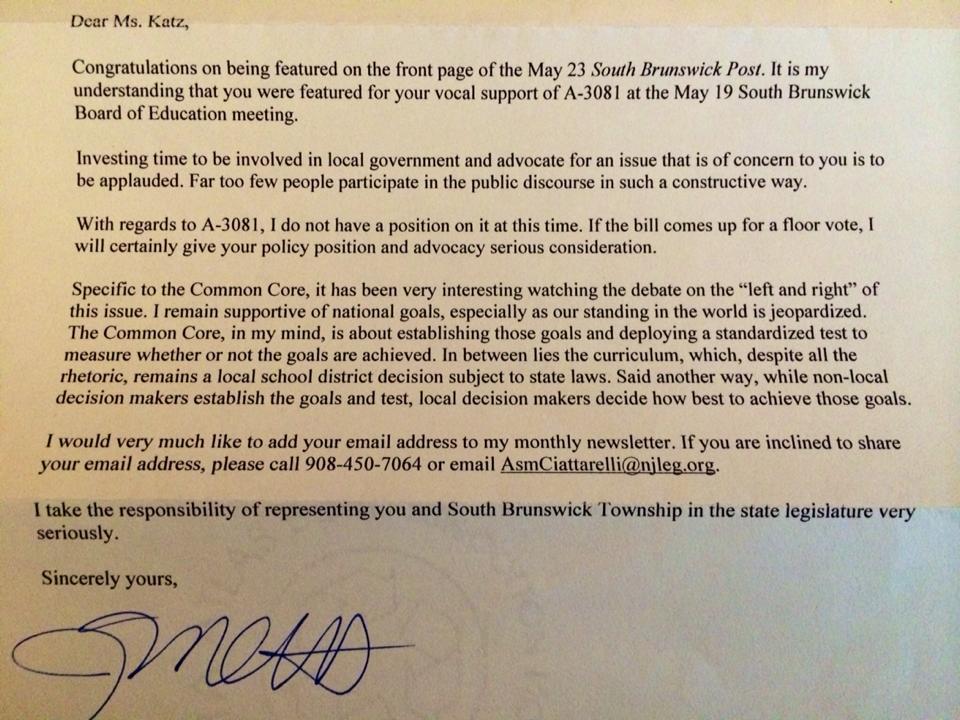
On June 28th, I received a letter in the mail from Assemblyman Jack Ciattarelli, representative for Legislative District 16. The letter is dated June 5th, but was mailed to the incorrect address (another young woman with the name Melissa Katz lives only a few minutes away from me, so it was accidentally sent to her. She was so kind to contact me and forward me the letter). Because the letter was sent to the wrong address, I received it in the mail about a week and a half after the full assembly vote on A-3081 (now also S-2154). To me, this was actually meant to be, because I am now viewing and writing about the letter after the full assembly vote.

Oh, and did I mention he voted no?

Assemblyman Ciattarelli was one of four people [DiMaio (23rd district), Bramnick (21st district), O'Scanlon (13th district), and Ciattarelli (16th district)] to vote no on A-3081. This bill would stop the punishments of new reforms and create a task force of experts to explore alternative ways of assessing students. The task force also would examine the new teacher evaluation system and implementation of the Common Core Standards. More specifically, this task force would review the implementation of the Common Core State Standards in English-Language Arts (ELA) and mathematics, the use of the PARCC assessments, and again the implementation and potential effects of the teacher evaluation system under TEACHNJ and AchieveNJ.

“This bill establishes the Education Reform Review Task Force to analyze the implementation and potential effects of the adoption of the common core state standards, the teacher evaluation system, and the use of assessments developed by the Partnership for Assessment of Readiness for College and Careers (PARCC assessments).

“The bill also stipulates that the student growth percentile, a measure of how much a student’s test score has changed relative to other students who have a similar test score history, may not be used in a teaching staff member’s summative evaluation until the task force submits its final report, or two years after the bill’s effective date, whichever occurs later.  Similarly, the bill also states that the assessments developed by the Partnership for Assessment of College and Career Readiness (PARCC) may not be used for any accountability provisions, including as the high school graduation requirement, until the task force submits its final report, or two years after the bill’s effective date, whichever occurs later. Also under the bill, a school district would have the option of administering the PARCC assessment online, using a pencil and paper format, or a combination of the two, in the two school years following the bill’s enactment.”

Only about a month earlier, myself and another parent from my home district of South Brunswick had a one-on-one meeting with both Assemblyman Ciattarelli and Assemblywoman Donna Simon (also representing District 16) at our public library. We spoke to them for about 20 minutes regarding education reform as a whole, and specifically the importance of A-3081. Simon voted yes in committee, but abstained during the full vote. In an email she wrote the following: "However, there were concerns and questions raised during committee that have not been fully addressed, which is why I abstained during the last meeting of the General Assembly." I emailed her asking what her concerns were, but received no response.

As far as Ciattarelli, he told us in this meeting that he had not made a decision on how he would vote, but would listen to all sides of the argument and then decide from there. While I respect this decision, and agree that it is extremely important to listen to both sides of an argument, I take issue when the information being looked at, and needed to make these kinds of decisions, is factually incorrect - I will break down his letter and share my issues with his statements.

Let me start by adding that I do appreciate the letter I received from Assemblyman Ciattarelli. As I said, although I disagree with his statements, being recognized for the work you're doing is always nice, and it is crucial to have open and honest communication with our legislators.

Now, let's get into the nitty gritty.

“Specific to the Common Core, it has been very interesting watching the debate on the ‘left and right’ of this issue. I remain supportive of national goals, especially as our standing in the world is jeopardized.”

Really? Really? Are we still talking about this? This type of statement emerged after Sputnik in 1957, and was put into the hands of the national media with the publication of “A Nation At Risk” in 1983. This type of language is meant to be used as a scare tactic, the same way “A Nation At Risk” stated, “if an unfriendly foreign power had attempted to impose on America the mediocre educational performance that exists today, we might well have viewed it as an act of war.” An act of war? Again, the use of language to instill in people a sense of fear, alarm, and despair. More recently, the results from the PISA (Programme for International Student Assessment) are being used as the new nation-at-risk.


“Thirty years ago, a federal report called ‘A Nation at Risk’ warned that we were in desperate trouble because of the poor academic performance of our students. The report was written by a distinguished commission, appointed by the Secretary of Education. The commission pointed to those dreadful international test scores and complained that “on 19 academic tests American students were never first or second and, in comparison with other industrialized nations, were last seven times.” With such terrible outcomes, the commission said, ‘the educational foundations of our society are presently being eroded by a rising tide of mediocrity that threatens our very future as a Nation and a people.’ Yet we are still here, apparently the world’s most dominant economy. Go figure.
“Despite having been proved wrong for the past half century, the Bad News Industry is in full cry, armed with the PISA scores, expressing alarm, fright, fear, and warnings of imminent economic decline and collapse.
“Never do they explain how it was possible for the U.S. to score so poorly on international tests again and again over the past half century and yet still emerge as the world’s leading economy, with the world’s most vibrant culture, and a highly productive workforce.”
“Daniel Wydo, a teacher in North Carolina, sent this analysis of 2012 PISA:
“Here’s what the mainstream media will NOT tell you about 2012 PISA. When comparing U.S. schools with less than 10% of students qualifying for free/reduced lunch, here’s how U.S. students (of which almost 25% are considered poor by OECD standards and of which nationally on average about 50% qualify for free/reduced lunch) rank compared to all other countries including one I chose to purposely compare – Finland (of which about 5% are considered poor by OECD standards):
*Shanghai is disqualified for obvious reasons.
Science literacy:
  • U.S. schools with less than 10% free/reduced – score=556 [1st in the world]
  • Finland – ranked 4th in the world
Reading literacy:
  • U.S. schools with less than 10% free/reduced – score=559 [1st in the world]
  • Finland – ranked 5th in the world
Mathematics literacy:
  • U.S. schools with less than 10% free/reduced – score=540 [5th in the world]
  • Finland – ranked 11th in the world
“This is not a new phenomenon. For every administration of PISA... when controlling for poverty, U.S. public school students are not only competitive, they downright lead the world. Even at home nationally, when controlling for poverty, public school students compete with private school students in Lutheran, Catholic, and Christian schools when analyzing NAEP data.”
http://christinemccartney.files.wordpress.com/2013/05/pisa.jpg
I personally question if these tests and rankings even mean anything. Do we really want to be first in the world in the category of testing? What about creativity, individuality, and outside-of-the-box thinking? Oh wait I forgot - silly me! - those things aren’t quantifiable, so the Department of Education could really care less about those things. Keith Baker, former researcher at the Department of Education wrote an article entitled “Are International Tests Worth Anything,” and Ravitch reports his following conclusion: “What has mattered most for the economic, cultural, and technological success of the U.S., is a certain ‘spirit,’ which he defines as ‘ambition, inquisitiveness, independence, and perhaps most important, the absence of a fixation on testing and test scores.’”

“The Common Core, in my mind, is about establishing those goals and deploying a standardized test to measure whether or not the goals are achieved. In between lies the curriculum, which, despite all the rhetoric, remains a local school district decision subject to state laws.  Said another way, while non-local decision makers establish the goals and tests, local decision makers decide how best to achieve those goals.”

I take a few issues with this statement. First, it makes me go insane when anyone makes statements saying things like “despite all the rhetoric” (rhetoric: language that is intended to influence people and that may not be honest or reasonable) or “despite the misinformation.” As I wrote in my previous piece about JerseyCAN, quoting that there is ‘misinformation’ out in the public is another tactic used by the reformers. “There’s a lot of misinformation out there in the public. Trust us (the reformers), we have the best interest at heart for students, teachers, and schools. Everything we do is for the students.” Translated: you’re colossally stupid and misinformed, so let us reformers make the decisions that impact every student, teacher, and school despite our complete lack of educational experience. ‘Misinformation’ has recently become one of those infamous buzzwords that the reformers seem to love, along with some of my personal favorites like ‘rigor,’ ‘accountability,’ ‘effective,’ and a slew of other words to convince the public that our schools are failing. Our nation needs all of these reforms – more ‘’rigorous’ standards, only the most ‘highly effective’ teachers – to bring our schools to an internationally competitive level because our students, teachers, and schools have been failures up to this point.
Regarding the bulk of this above sentence, his statement pretty much saying that Common Core is not curriculum doesn’t sit well with me either. According to Truth In American Education, in their “Myths vs. Facts About Common Core:”
Myth
.  Under Common Core, the states will still control their standards.

Fact.  A state that adopts CC must accept the standards word for word. It may not change or delete anything, and may allow only a small amount of additional content (which won’t be covered on the national tests).
Myth
.  Common Core is only a set of standards, not curriculum; states will still control their curriculum.

Fact
.  The point of standards is to drive curriculum. Ultimately, all the CC states will be teaching pretty much the same curriculum. In fact, the testing consortia being funded by USED admitted in their grant applications that they would use the money to develop curriculum models.
And as Peter Greene writes in his blog Curmudgucation, which I will once again reference:
“But the Core are copyrighted, and if you want to use them, you must do so as is, with not a single change. States may add up to 15% on top of what's there, but they may not rewrite the CCSS in any way, shape, form, jot, tittle, or squib. States cannot adjust the standards a little to suit themselves. They cannot adapt them to fit local needs. They can't touch them.
Even more importantly (and incredibly) there is NO process for review and revision...
If you found what you considered to be a terrible mistake in the CCSS, there is no place you can call, no office you can contact, no form you can fill out, no appeal process you can appeal to, no meeting of the board you can attend to submit your comment, no set of representatives you can contact with your concern. There is nothing. The CCSS cannot be changed."
Is Assemblyman Ciattarelli bothered by any of this? How about the fact that Pearson won the contract for PARCC testing in a not-so-kosher way? There is a slew of controversy and backlash - serious backlash - over Common Core, PARCC, high-stakes testing, and changes in teacher evaluations. These are just some aspects of the reform movement on the national stage, but locally and statewide there are issues with charters, state-controlled districts (have you been following the disaster in Newark with state-appointed superintendent Cami Anderson?), and serious socioeconomic and racial biases as consequences of these reforms (read Bob Braun for more on this in New Jersey).
I don’t know the exact reason Assemblyman Ciattarelli voted no, but it disappoints me that people in positions of authority who are creating education policy continue to ignore hard evidence and testimony from concerned citizens over issues with these reforms. I would hope that eventually Assembly Ciattarelli will give a concrete reason for voting no, and more than that back it up with concrete evidence to support his reasoning and claims.
I’m not holding my breath on that one.    
And more importantly, I will remember this come November.
**Important note: this past Monday, June 30th, the full Senate was set to vote on S-2154, the Senate version of A-3081. At some point during the day, Senate President Steve Sweeney decided to pull the bill, as he is apparently in negotiations with Governor Chris Christie to create a “compromise” (whatever that is going to look like, I imagine it will not do much as Governor Christie is a huge fan of the education reform movement). Governor Christie does not want to sign this bill, but he also does not want to outright veto it because of the overwhelming bipartisan support. Sweeney, on the other hand, is negotiating with the Governor because of his concern that there will not be enough Republican votes to override a veto - you’ve gotta love politics! Governor Christie or Education Commissioner David Hespe will most likely present this compromise at the next State Board of Education meeting on July 9th, and if the State Board of Ed does not agree to slow down, he will apparently put the bill back up for a vote on July 10th. Stay tuned.**

10425043_238687173007640_4134943371812067218_n.jpg

Monday, June 30, 2014

Samantha Reilly: Melissa Katz - Reviving Education by Tearing it Down

Written by Samantha Reilly, South Brunswick High School Class of 2014
Originally published in The Viking Vibe 

The name “Melissa Katz” rings a few bells around South Brunswick as a 2013 graduate of SBHS, but as the district approaches the implementation of PARCC testing, Katz approaches a new status as a household name in terms of education reform movements.

Katz recently spoke at a local Board of Education meeting to express her less-than-subtle views on what the board is doing versus what the board should be doing. To say she is not a fan of PARCC is a grotesque understatement, one which cannot compete with the volume at which she speaks to the community on a daily basis.

Katz, an 18-year old who recently finished her freshman year as an Urban Elementary Education major at TCNJ, looks and acts like any other college student. But then comes her eloquent, wise-beyond-her-years speech to accompany a perfectly tabbed, highlighted, and labeled binder of educational statistics and testimonies against PARCC testing. Said binder is “one of six”, she explained.

Having graduated from high school and not yet begun a professional career in teaching, Katz is stuck in a disconnected limbo of sorts, one may say. She chooses to see it differently.

“I love [that] I’m in a really unique position that allows me to speak out and say what I want without really having any consequences because I’m in that in-between stage,” Katz said. “I’m trying to take advantage of it.”

So the question arises: what causes this non-student, non-teacher, former Viking to hold such adamant, fervently-expressed beliefs about education here?

“I may not be teaching yet, but the day I step into a classroom,” said Katz, “ ‘effective’ is going to decide whether I keep my job or not.”

She refers to “effective” as a “buzzword reformers like to use” to determine a teacher’s worth to the system as a whole, and so begins her long list of issues with reformers in the educational world, South Brunswick’s board included.

“I am trying to get our board to be more vocal and take a stance on the many issues in education,” said Katz.

She then began to explain the many, many, many issues with education, most of which slip right under the noses of those with the most power to resolve them, she said.

“What you see a lot across the country is boards of education are not the most educated people on education. They’re usually business people,” said Katz, “Not just our board [but] boards everywhere, need to start educating themselves on what’s going on because they’re making decisions that impact every single child in this [district] and around the state and around the country.”

The concept of reform in education is evident nationwide. The rise of PARCC as the latest educational standard has provoked an abundance of criticism and controversy throughout the United States.

“The whole reform movement is coming from all sides,” said Katz, “It’s coming from Republicans and it’s coming from Democrats and conservatives and liberals… It’s parents and students and teachers, and in some cases principals, and in some cases superintendents and districts standing up and saying, ‘This is not what we want for our kids. This is not what real education is.’”

To understand PARCC and Melissa’s opposition to it, it is important to understand the motives under which reformers operate. According to a global report conducted by the education firm Pearson in 2012, the United States ranks 17th in the developed world for education as a whole: 25th in math, 17th in science, and 14th in reading, as reported by The Huffington Post on November 27, 2012.

The United States, under the pressure of upholding its prestigious global reputation, has broken into a hysteria, she said, incapacitated by the idea that the US is not the best and the brightest.

A commonly overlooked factor, though, is the child poverty levels in each respective country. Finland, for example, leads in education according to the 2012 study, but also ranks as the country with the lowest relative child poverty rate. Merely 5% of children aged 0-17 in Finland are living in households with incomes below 50% of the national median, according to a UNICEF study alluded to by The Washington Post. The United States has a whopping statistic of nearly 25% of children suffering in that respect.

“In urban districts you see lower test scores and it’s not because they’re not smart. Kids in urban districts are dealing with poverty,” said Katz.

Educators and boards are tangled in a web of statistics and confounding variables that prove that education is as affected in the world as it is effective in shaping the future. Nevertheless, these global comparisons relentlessly rely on Program of International Student Assessment (PISA) scores, and PISA scores alone, to determine who takes the lead in this academic race.

PISA, sponsored by The Organisation for Economic Co-operation and Development (OECD), is a test conducted every three years which assesses 15 year olds’ capabilities in the areas of reading, mathematics, or science. Over 28 million students from 65 countries were assessed in 2012. The next PISA testing will test students on science in 2015, according to http://www.oecd.org/pisa/aboutpisa/.

According to a letter written against PISA as reported by Deseret News, “PISA has ‘assumed the power to shape education policy around the world,’ using ‘tests widely known to be imperfect.’”

Now this reliance on testing and scores approaches South Brunswick in the form of PARCC, stripping students of the safety and comfort of their hometown. Because, apparently, it no longer takes a village, but rather standardized tests and scantron sheets to raise a child, and South Brunswick’s participation in pilot PARCC testing only propels this idea, according to Katz.

Recently, she left her audience with a strong message after her speech at the Board of Education meeting on May 19, saying, “The kids in this community are not guinea pigs for the state, corporations, big businesses, and venture philanthropists to experiment on.”

The students of SBHS agree. South Brunswick senior Chelsea Richardson said, “Pilot testing is funded by corporations that are not made up of teachers or educators, but of people who are trying to make a profit off of the education system. Their intention is not to create a valid measure of intelligence.”

As Katz said, “Our test scores basically define our education, nowadays. If you break it down by poverty levels, the United States generally outperforms every nation in the world, but no one wants to say that. Because if the schools aren’t failing, they can’t implement their reforms. You have to sell the tale of failure.”

Katz persistently works to unmask supposedly helpful programs in place in public schools. Organizations such as Teach for America claim themselves to be vigilantes avenging educational decline, but Katz sees the situation differently.

“It is a fundamentally flawed program,” she said.

Katz is currently enrolled in a five-year undergraduate program to prepare her for teaching in urban districts. A Teach for America alter ego would receive merely five weeks of training before entering an urban district.

Her passionate attitude holds a strong social presence, both physically and electronically. Katz frequently utilizes Facebook as “an activism tool”, as she describes it. She posts on her personal page and is an active member of the Facebook group, “SB Cares About Schools” which recently reached 500 members.

“I post about 50 articles a day,” said Katz, “I’m surprised everyone hasn’t unfriended me.”

But her efforts are sensibly and passionately rooted. She spoke fervently about the lack of education about education. Even education majors seem uninformed or misinformed about the policies in place.

“Many of them have never heard of Common Core or PARCC and in a lot of places it’s already in the schools,” said Katz. “It’s here, and there’s a lot of people who don’t know about it.”

Katz maintains a strong presence in the anti-educational reform movement, and it is clear that her efforts have and will continue to extend beyond South Brunswick. Her name no longer refers to just another graduate. She is on her way to becoming a hero to education, by tearing down what education has come to stand for.

“There is an attempt to completely overhaul public education,” said Katz, “and it’s time to fight back.”